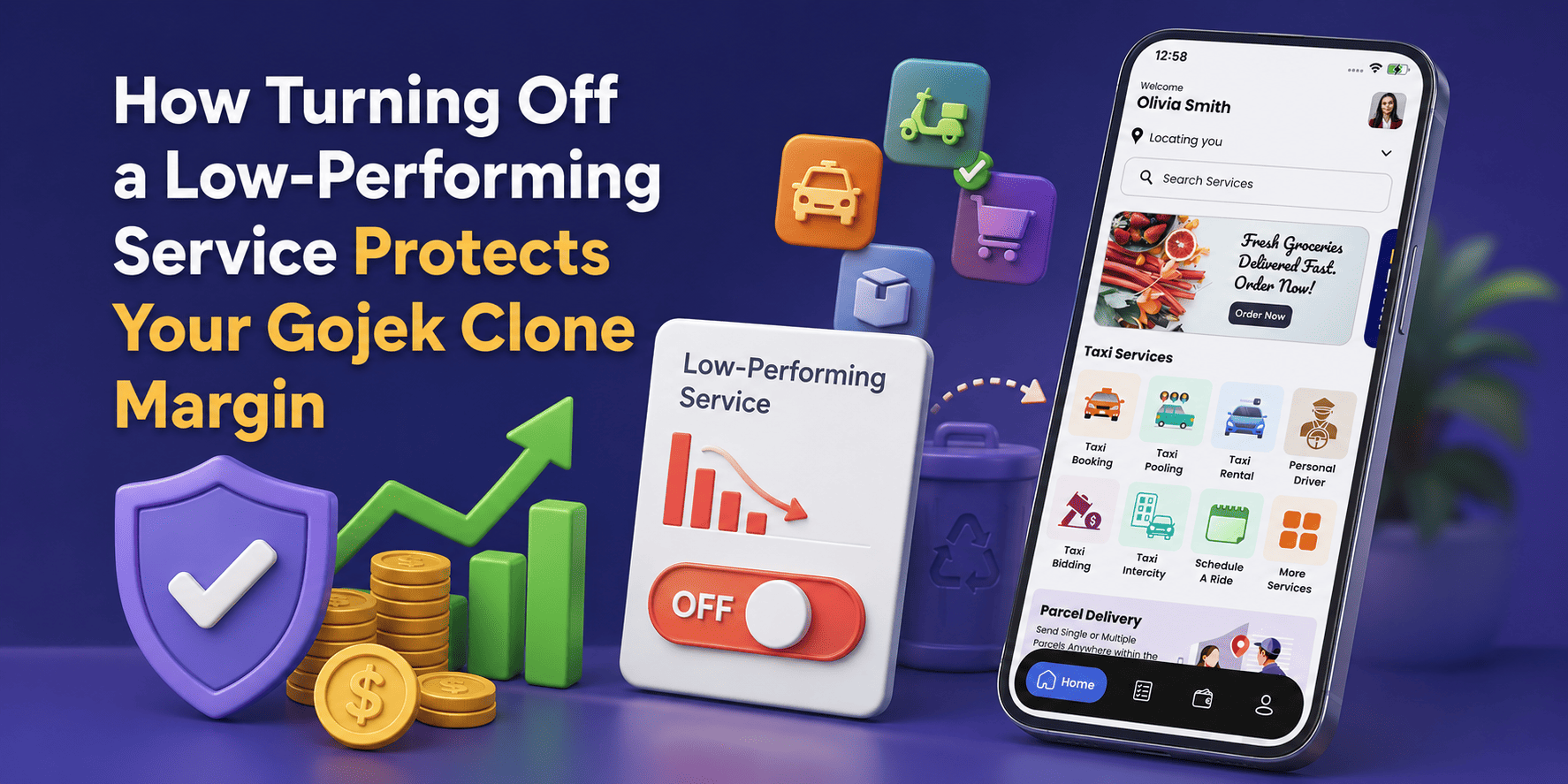
Running a multi-service app, like any other app that offers a wide range of services from one place, requires clear thinking about maintaining a balance between growth and transparency.
Any owner interested in buying a Gojek clone app or any ready-made Gojek clone script naturally assumes that adding more services means more profits, which is true, like adding a food delivery or taxi booking to one local, on-demand app. But this doesn’t mean that the platform gets more profits just because the service list gets longer.
A super app solution made on a flexible Gojek clone script allows business owners to add categories through the admin panel quite easily. The same admin panel also gives them the ability to stop or remove categories that are not making enough profits.
Is Profitability in a White Label Gojek Clone Always Up?
When starting a white label Gojek clone, like any other app that offers multiple services, business owners usually begin with four main services, like taxi booking, store deliveries, parcel delivery, and on-demand services.
Any owner can then add more services from the fourteen extra options, like medical, beauty, or car care, based on local demand. In the beginning, every service gets equal marketing money and support, which makes sense because nobody knows which service will get more bookings in a specific city. But after running the app for a few months, things become clear as one service brings in most of the bookings while another service, like pet care, gets almost zero activity even after spending money on promotions.
Why?
Because companies across industries are increasingly reallocating resources toward their “biggest bets” to drive earnings growth. And that’s why owners have to make a choice to either keep spending marketing money on all services equally, hoping the weak ones will grow, or put their money into the services that are already making profits.
The admin panel allows them to manage this easily without rebuilding the whole app. Any owner interested in running a Gojek clone app naturally assumes that offering a long list of services means more profits, but companies putting their money into their best-performing services actually see their profits increase compared to investing in all services equally.
In fact, 51% of 1,326 finance leaders prioritized more precise cost-management approaches and tighter oversight to protect margins. Relevant to what we are talking about, the statistics represent the modern-day entrepreneurial mindset. Because every active service needs its own service providers and customer support time, which is true, like a taxi booking or a smaller one like dog walking.
Even a service getting very few bookings still takes up the support team’s effort, and running a lot of services without tracking the profits of each one makes the platform quite likely to see overall profits drop over time.
Giving the Business A Scale Back for a Low-Performing Category
Instead of just looking at last week’s numbers, business owners usually check a few months of booking data from the admin panel to understand if a service is actually doing poorly or just facing a slow season.
The profit and cost for a single booking are different for each service, which is true, like a taxi ride making a small profit from the commission, while a parcel delivery makes almost no profit after paying the delivery partner and giving discounts.
If providers rarely log in to accept jobs, it means that the service is already failing on their end, even if customers still want to book. So comparing the cost of getting a customer with the actual profits makes it clear if spending more marketing money is really worth it. A flexible Gojek clone script allows business owners to stop a weak service through the admin panel quite easily, so the saved marketing money and support time can go into services that are already getting lots of bookings.
Even if a small number of users still rely on the stopped service, sending them an early in-app message helps keep their trust. New owners usually start with a lot of services because the admin panel adds them quite easily, but over time, the apps making more profits are the ones that regularly check their services based on actual bookings rather than guessing what a multi-service app should have.
Best-Performing Services Help Main Profits Grow
Moving the budget into the best-performing services helps maintain profit growth. This doesn’t mean stopping services is always the best choice, but it requires clear thinking about putting money into what works to help the business make more profits.
Any owner interested in buying a ready-made Gojek clone or a custom white label Gojek clone naturally assumes that services taking up marketing money and support time without making enough profits will eventually bring down the whole app’s profits. A super app solution made on a flexible Gojek clone script allows business owners to stop these weak services, even for a short time, through the admin panel quite easily, to give the better-performing services room to grow.
Final Thoughts
Stopping a service might upset some current customers, which is true, like when a small group of users uses that service a lot, but sending an early message and suggesting other options requires clear thinking about maintaining transparency. The same admin panel also gives them the ability to turn a stopped service back on later if people start wanting it again, making it much easier than starting it for the first time. To decide which service gets more marketing money, business owners usually compare the cost of getting a customer against the actual profits to spend their money on the ones that mean more profits.
FAQs
1. Are services on my app underperforming or just going through a slow period?
Taking data for over several months instead of a couple of weeks gives a clearer picture of the entire tenure of the services and also the customer behavior shift. Seasonal dips happen in any business, so patience is the key before making any permanent decision.
2. Can a paused service in my super app platform be later activated?
In many cases, yes. Since the underlying setup often remains in place, reactivating a paused category later tends to be far simpler than launching it the first time.
3. How do operators decide which category deserves more marketing budget?
They compare how much it costs to acquire a customer in each category against how much revenue that category generates, then direct future spending toward whichever shows the healthier ratio.