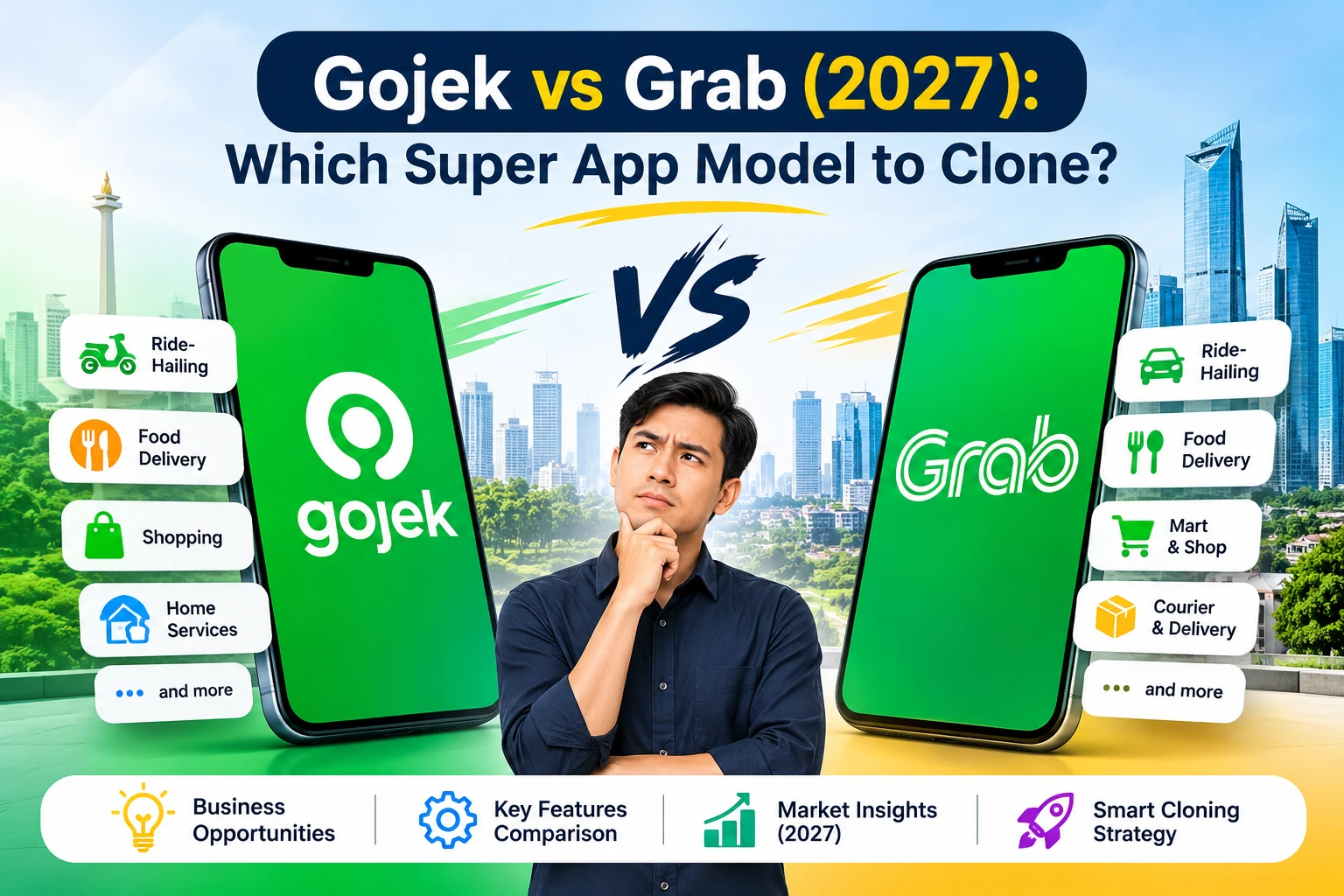
In the development of multi-service businesses, the selection of proper technology and operating model will be the crucial foundation for a successful, sustained operation of such enterprises. The comparison of Gojek vs. Grab presents two approaches for building a super app.
Both platforms provide an assortment of daily services such as transport, meal delivery, payments, and logistics; however, their expansion strategies and business priorities vary from each other.
For entrepreneurs who planning for a super app in 2027, this information can demonstrate various peculiarities and help to make the choice of the development model in accordance with the market needs, investment opportunities, and growth strategy.
Understanding the Gojek vs Grab Business Model
Although both companies have developed their own multi-service platforms, each used different types of approaches and market strategies to reach their preferred target audience.
To comprehend the contrasts between the Gojek vs Grab business models, it is necessary to analyze how they started:
Gojek:
- It started with motorcycle transportation in Indonesia and grew into food delivery, logistics, payment, and other fields of activity.
- The strategy of building a vast digital ecosystem that includes a range of everyday services and delivers them through a single platform.
Grab:
- Originally a taxi booking service in Malaysia, it later emerged as a ride-hailing business along with delivery, finance, and other service aspects.
- The strategy of a mobility and delivery application that expands from the original concept to other areas like payments and others.
Both approaches show how a particular service can lead to the creation of a large digital ecosystem.
Gojek vs Grab Super App: Key Differences
The difference does not consist solely of the number of services provided in this regard, but rather of the way in which the businesses develop and manage operations.
| Comparison area | The Gojek model | The Grab model |
| Strategy of growth | Different services for everyday needs | Transportation and delivery |
| Expansion activities | Establish service networking in the main market | Further develop core services and grow to new geographical areas |
| Service environment | Transport, food, logistics, payments, etc. | Transport, food, groceries, delivery services, and finance |
| Business goals | Establish continuous use of various services | Grow core activity and offer clients additional services |
| Targeted market | Markets with high density and various local needs | Markets with high mobility and delivery demand |
For Gojek vs Grab super apps, the preference should depend on what the local rider’s behaviour is like and how well the company manages its different service categories.
Gojek Clone vs Grab Clone: Which Features Should Be Included?
Both models demand connected applications for customers, service providers, and administrators. Nonetheless, the original feature priorities may vary.
A Gojek-style model may focus on:
- Many service categories with only one account.
- Different workflows for drivers, merchants, and service providers.
- Food, grocery, transport, and local service bookings.
- Centralized services and payments.
- Ease of service expansion.
A Grab-style platform may focus on:
- Driver booking and driver allocation
- Food and grocery delivery management.
- Allowing users to track the ride in real time and make payments online
- Supervising merchants and delivery partners
- Loyalty programs and extra financing services, if allowed by law.
When choosing a Gojek clone vs. Grab clone, it is important to understand how the workflow must function at the launch. It may not be necessary for the platform to have all the features similar to those of the original companies to be effective at the beginning.
Which Super App Business Model Offers Better Revenue Opportunities?
Both models can earn revenue via various channels. The difference, however, is in the order of preference assigned to those revenue sources by businesses.
Revenue Source ➔ How Businesses Generate Revenue
Ride Fees ➔ Commission from completed rides
Delivery Fees ➔ Fees paid by restaurants and merchants
Delivery Charges ➔ Fees paid by customers for delivery services
Subscription Fees ➔ Recurring payment for membership
Advertisements ➔ Payment for merchants’ advertising services and positioning
Financial Services ➔ Income from facilitating payment and financial transactions.
A successful super app business model must not rely solely on ride commissions, as additional channels of revenue can help businesses navigate shifts in demand and competition in pricing.
Public documents from Grab confirm that the importance of diversifying revenue segments cannot be overstated. The company generates income through transportation services, logistics, and financial services.
Which Model Should Entrepreneurs Choose in 2027?
Selecting the optimal strategy is reliant on the specific needs of the business as well as the state of the market demand and what the business wishes to achieve in terms of expansion.
Select a Gojek-style approach if:
- There are a number of everyday services that will effectively be utilized in the local setting.
- The business is also able to create new partnerships with service providers.
- Establishing a single platform for multiple customer needs is the main goal.
- The company wants to be effectively positioned in a focus market.
Select a Grab-style approach if:
- Transport or delivery is the best market opportunity.
- The business has access to drivers, fleets, or merchants.
- A gradual expansion strategy is preferred.
- The long-term strategy includes expanding into cities and far locations.
For many start-ups, it is easier to roll out 2-3 services initially than to introduce a comprehensive range of service catalogue at once. Additional categories can be added after demand, provider availability, and revenue performance are established.
How V3Cube Supports Super App Development
To create a multi-service platform from scratch, businesses need to conduct distinct development activities for the consumer app, service provider application, payment systems, and admin app. V3Cube provides the option of ready-made clone app solutions that can serve as the base for businesses that want to develop platforms like Gojek or Grab.
Gojek clone app will be ideal for those businesses that seek comprehensive multi-service solutions, while a Grab clone app will be a better match for businesses focused mainly on transportation and delivery operations.
The pre-existing structure provided by V3Cube pre-built foundation helps in decreasing the extent of basic development activities compared to crafting each fundamental component separately. Businesses also have the opportunity to discuss branding, feature selection, and any variations necessary for the project.
If businesses want to make the right decision on whether or not to purchase from V3Cube, they should consider the demonstration of the product, available modules, software licenses and source code, payment methods, the cost of customization, and technical assistance.
Important Factors Before Starting Super App Development
Prior to making any investments in either model, it is critical that entrepreneurs assess the following aspects:
1. Market Demand: The entrepreneur must find out the most in-demand services that customers need.
2. Availability: It is crucial to see if there are enough drivers, restaurants, and specialists to start the business.
3. Payment: The entrepreneur should figure out which local payment services can be used in accordance with applicable legislation.
4. Operating Expenses: It is equally important to calculate marketing and support expenses as well as the costs of monitoring service providers.
5. Scalability: Select technologies that would allow the addition of more services later on as the business grows.
Super app development is not only about putting too many services together into one app. The app should contain the process of operation for every service and the way the services will generate revenue.
Conclusion
Both Gojek and Grab provide effective ways for establishing multi-service businesses. The concept of Gojek-style is more relevant for entrepreneurs planning to manage more than one day-to-day service, whereas the Grab-style model is a good example of how companies can evolve from their core services in the transportation and delivery area to an entire ecosystem.
The right solution depends on market demand, available resources, and the particular business aims in the long run. Thanks to a ready-made solution developed by V3Cube, entrepreneurs can implement necessary technologies and focus their time on developing the service model that meets the needs of the target markets.
FAQs
Q1. Is Gojek better than Grab for starting a super app business?
Neither of them is better than the other. Gojek employs an ecosystem-oriented strategy, while Grab uses a mobility- and delivery-oriented expansion strategy.
Q2. Can a Gojek-style app include Grab-style features?
It is possible to use features of both approaches in one platform as long as its systems and processes allow for integration.
Q3. How do super apps make money?
Typically, they create revenues generated from commissions, delivery fees, subscriptions, marketing, and all licensed financial activities.
Q4. Is a ready-made clone app suitable for a startup?
Yes, it can make use of an existing technology platform as well as minimize the volume of initial developers’ work.