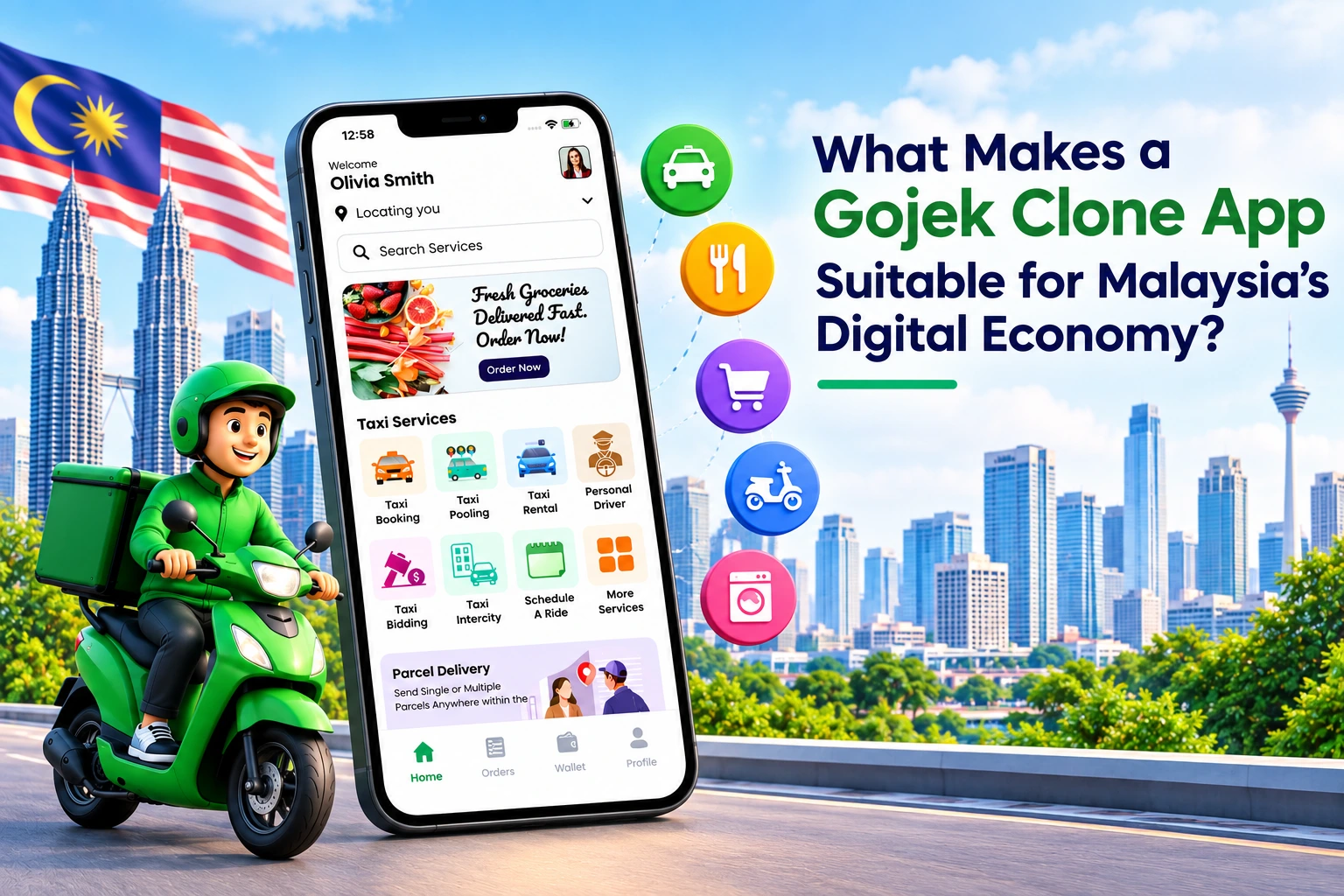
Malaysia’s rising trend of adopting digital payment methods, online shopping, and mobile services offers firms the chance to provide customers with better accessibility and convenience.
A Gojek Clone Application in Malaysia offers the chance for businesses and entrepreneurs to offer a number of services like transportation, food delivery, grocery purchases, and home upgrading through this digital platform.
Instead of a business managing applications for different services, it can create a connected system comprising reservation, payments, and service management aspects.
Nonetheless, success is not just about technology. In order to make a successful platform that fits Malaysia’s digital marketplace, it is important to gain a thorough understanding of local customers’ needs, select the right services, and devise a sustainable revenue model.
Why Malaysia Is Ready for Multi-Service Platforms
With consumers’ growing demand for on-the-go services to be accessible through their smartphones, businesses are becoming more interested in how they can practically provide those services, streamline operations, and better manage their digital orders.
The multi-ethnic population of Malaysia, the presence of established metropolitan areas, and the increasing use of online services provide possibilities for platforms that incorporate several day-to-day service needs. Entrepreneurs can start with specific cities or customer groups in particular locality before broadening their scope.
The multi-service application in Malaysia allows customers to reach restaurants, retailers, delivery partners, transportation companies, and local professionals through one interface. This model can add value to those customers who are seeking convenience and can help businesses that are looking for additional sales channels.
The greatest opportunities usually come as a result of solving a specific local problem, instead of trying to roll out the maximum number of services as quickly as possible.
How a Gojek-Style Platform Supports Digital Transformation
Digital transformation in Malaysia means more than just transferring traditional services online; it also means improvements in businesses’ order management, ways of communicating with customers, coordinating service providers, and working with operational data.
A multi-service platform can support this shift in several ways:
Centralized service management: Businesses can manage various service categories through a shared administrative system.
Convenient customer access: Customers can access various services from a single app to request a specific service and be updated through one application.
Improved coordination: Service providers can obtain requests and oversee service availability electronically.
Better business insights: Reports will provide operators with details about demand, revenue patterns, and client behavior.
Flexible expansion: New categories of services can be launched as the business has more customers and service partners.
For small and medium-sized businesses, these capabilities help establish a structured approach to their expanding digital operations that gets rid of the need to implement a new platform for every service.
Essential Features for a Reliable On-Demand Service App
A proper on-demand service app in Malaysia must be developed to make it simple for customers to find specific services as well as service providers. The feature set of the app may vary according to the business model but there are some key functionalities that can be useful.
| Feature | How it supports the business |
| Smart service discovery | Groups related services; helps customers discover the most suitable services according to their needs. |
| Real-time availability updates | Lists available providers, thus reducing delays in booking procedures. |
| Flexible fare and pricing controls | Enables businesses to configure service prices, commission, and other charges regarding services. |
| Driver and provider verification | Provides onboarding checks that improve accountability and consumers’ confidence. |
| In-app communication | Offers support to the customers and providers in clarifying pick-up details or any changes in their booking information. |
| Promotions and referral tools | Motivates first-timers to place orders, assists in bookings for more repeat usage, and motivates them to recommend the services to others. |
| Dispute and cancellation management | Gives administrators a systematic approach to handle refunds, complaints, and any changes in bookings. |
| Business performance insights | Assists in identifying the categories in demand, peak demand periods, and possibilities for improvement of operations. |
When configuring the app, businesses should also consider local requirements. These may involve appropriate payment methods, clear pricing policies, required languages, as well as workflows depending on the services used.
How Can Entrepreneurs Generate Revenue?
A multi-service business must develop a revenue structure that takes care of its operating expenses, but doesn’t make its offering unattractive to potential customers or partners.
- Commission-based earnings: Keep an agreed share of the amount derived from completed transactions.
- Delivery or booking fees: Charge a disclosed fee for any valid orders or bookings.
- Provider subscriptions: Provide payment plans for service providers that will obtain access to functions on the platform.
- Business partnerships: Generating revenue from contracts with shops, restaurants and corporate customers.
- Premium services: Offer optional features and specialized services only when needed.
Before starting the operation, entrepreneurs must carry out an estimate of the volume of transactions, average price per order, payment processing costs, marketing costs, and maintenance costs of the platform.
This understanding is necessary for determining the sustainability of further business development.
How V3Cube Helps Businesses Turn a Super App Idea into a Market-Ready Solution
V3Cube provides cloned application solutions that assist businesses in building a foundation to support platforms in achieving business objectives. By using Gojek Clone app development, businesses can develop a multi-service-oriented solution without having to work on the individual functions.
Regarding businesses that want to take advantage of super app development in Malaysia, V3Cube can help them to prepare the platform around relevant service categories while keeping in mind future objectives.
Instead of trying to incorporate all possible services at the beginning, an entrepreneur can pick a set of services that best match their local demands and consider other services only when they become necessary.
An elaborate demonstration can define what capabilities are available and what has to be customized in order to ensure that the solution meets the business’s future needs.
A full comparison of the information against the overall budget and objectives for launching the platform can facilitate the conclusion as to whether V3Cube is the right fit for the application to be developed.
A Practical Launch Plan for Malaysian Businesses
It is easier to create traction for an Gojek Clone app for Malaysian businesses after the launch through a well-defined and measurable process.
- Identify a market need
Studying customer expectations, local competition, and services that are hard to get or book.
- Build a dependable provider network
Discuss commission rates with partners, agreed-upon standards of service, cancellation procedures, and bifurcation of responsibility.
- Test before launch
Analyze the process of booking, payment methods, notifications, provider’s workflow, and customer service.
- Expand using real results
Evaluate completed orders and repeat bookings, customer ratings, as well as providers’ performance before launching new services.
Thus, it is essential for businesses to evaluate the applicable requirements for Malaysia, which include, but are not limited to, registration, taxation, consumer protection, personal data protection, payment, and licenses specific to the sector. Requirements will vary based on the type of service provided.
Conclusion
Entrepreneurs can leverage the opportunities presented by Malaysia’s digital market to link customers with service providers through user-friendly and integrated platforms effectively.
To succeed in this business, businesses should build a firm foundation by defining a target market, choosing the right features, finding dependable partners, and coming up with a viable revenue model to support future operations.
Gojek-style solution may become a good starting point for businesses interested in combining various services in a single app.
By evaluating V3Cube’s customizable offerings alongside competing options, confirming the full project scope, and launching in stages, entrepreneurs can make more informed technology decisions and build a platform suited to their business goals.
FAQs
Q1. Why is a Gojek-style app relevant to Malaysia?
It can combine a range of everyday services in one digital platform, which offers the opportunity to provide customers with easy access to services and gives businesses another way to connect with customers.
Q2. Can a small business launch with only a few services?
Yes. Starting from a few service categories will allow minimizing operational difficulties and help the business establish the demand for the future expansion.
Q3. How much does developing a multi-service app cost?
The expenses depend on the specific features, customization requirements, available integrations, support of the platform and the needed maintenance.
Q4. Can a clone-app solution be customized for local needs?
Customization requirements like branding, payment integration, choice of language options, and service workflow should be clarified before selecting the solution.