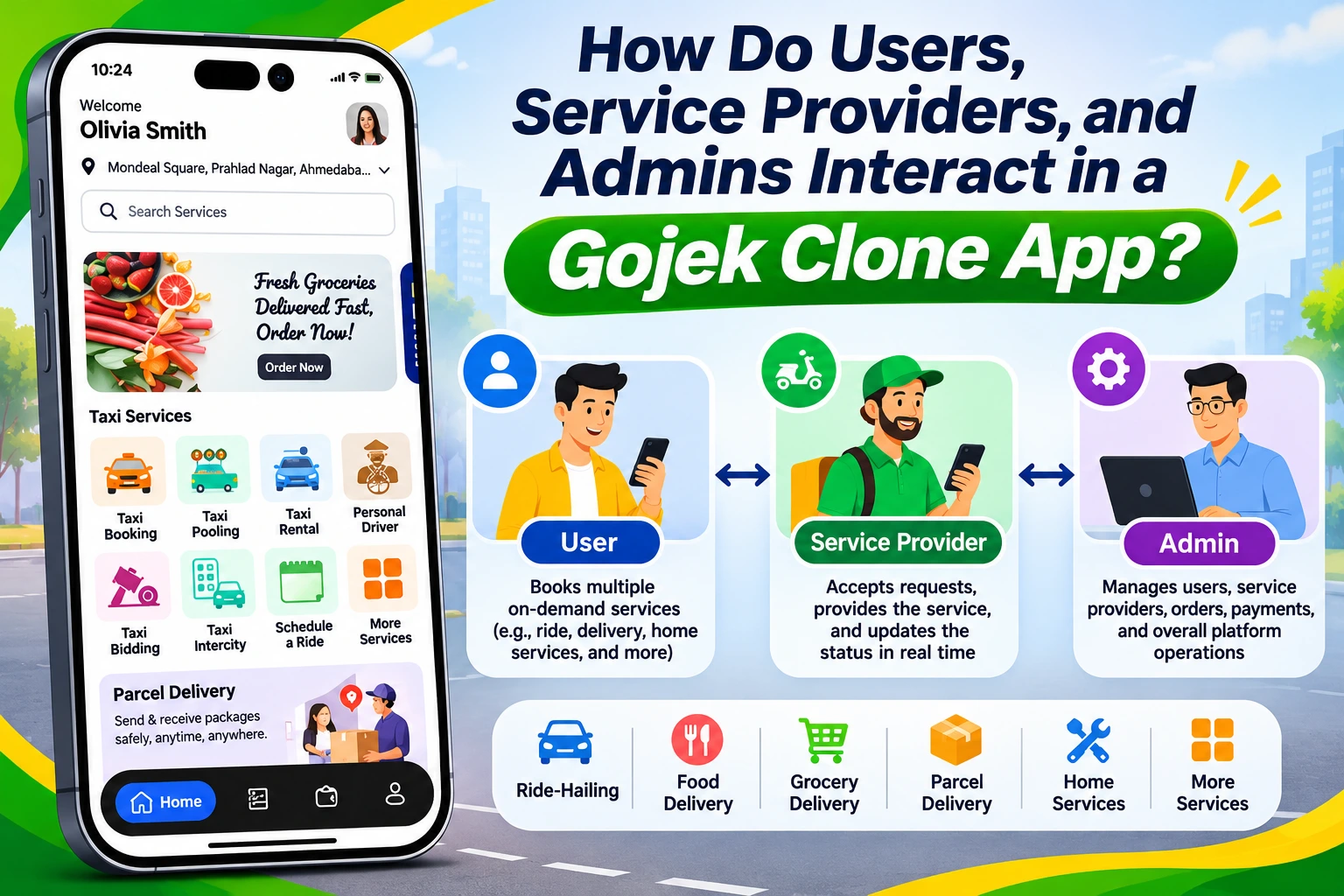
A Gojek Clone app helps customers interact with service providers and administrators through a single platform. Different participants perform different functions; however, their activities are interdependent for the proper functioning of the services.
The customers book the services through the app, the providers get the requests and fulfill them, and administrators oversee the efficiency of the platform.
Understanding the interaction of these three groups is essential for running a multi-service business. It helps identify the features each participant needs and how information moves from one stage to another.
Understanding the Three Main Participants
In general, a multi-service platform consists of three interconnected interfaces that function independently but contribute to the overall service experience.
- Users or customers interact with the multi-service platform by searching for the services they require, booking services, paying for them, following the status of their requests, and providing feedback afterwards.
- Service providers receive requests made by customers, manage their time and availability, provide services assigned to them, and track their revenues.
- Administrators oversee all accounts, categories of service, transactions, commissions, disputes, and everything else regarding the effectiveness and functioning of the platform.
While all these roles are different from each other, none operate independently. For example, a customer request may lead to a notification sent to a provider as well as updating the administration system.
How Does the Gojek Clone App Workflow Begin?
Gojek Clone app workflow begins when a customer logs into the app and chooses the service they desire. At that point, the platform begins coordinating the order with an available provider and provides constant updates about service processing.
The booking process includes:
1. Service Discovery
The user logs in and selects from a list of available services, including food delivery, hailing a ride, grocery shopping, or any household service, and to check whether any options are available at that moment.
2. Request for Booking
The user provides all the details required for placing the order, indicates a destination, and checks the amount of money they need to pay.
3. Receiving Notification from Provider
The system finds a suitable supplier available and notifies them about the request. The supplier may either accept or refuse it.
4. Realization of Our Services
Upon acceptance of the delivery of tasks, the service supplier takes responsibility for its performance. The customer may be informed as to the status and may also receive relevant information concerning its performance if the nature of the service allows.
5. Payment and Assessment of the Service Quality
As soon as the service has been performed, payment will be made according to the chosen method. All transactions and booking terms will be recorded for their further processing.
The whole process may differ due to the nature of the service provided. Requesting a ride with a taxi driver, for instance, will imply the allocation of a driver and route tracing. However, requesting the housing-related service also includes scheduling.
What Happens Inside the User Application?
The application for the customer is the primary entry point to the platform system. The goal is to facilitate service discovery, booking, and payment.
The application allows users to:
– Register accounts and modify customer data.
– Look through multiple categories of services.
– Check the providers nearby or available options.
– Place orders and confirm them.
– See the estimated prices and payment information.
– Track the orders and get to know the progress of the service.
– Communicate with providers and customer support.
– Rate the completed service.
The user-service provider interaction begins when a customer places an order and ends when the order is delivered and reviewed.
How Service Providers Receive and Manage Requests
Service providers must provide the services mentioned on the platform. The application the customer uses has to allow them to receive bookings, provide a communication line, and take care of the day-to-day operations.
The Gojek Clone Service Provider App basically consists of the following functions:
- Registration and account setup: Providers will enter their personal and business details as well as their service details to validate their account.
- Availability management: They can manage availability by toggling it on and off or manage their working hours.
- Handling bookings: Upon receiving bookings, they can either approve or reject them based on availability and the requirements of the services.
- Booking management: Providers can check the details of the customer, location of the service, and any relevant information related to the booking.
- Earnings overview: They will be able to see their completed bookings, commissions, and payment records can be reviewed.
- Communicating with customers: Options such as calling, messaging, and alerting will help when dealing with customers.
For instance, when the customer books a ride, the eligible driver gets a request to accept it. When accepted, the driver executes the trip and makes all the updates in trip status until the trip is finished.
How Admins Control the Platform
The administrator is responsible for overseeing and managing the entire platform so that customers and service providers can use it. The admin panel of Gojek Clone serves as the main point of control to monitor activities in different service categories.
The tasks of these administrators generally include:
- Administrators are able to monitor registrations, manage account-related processes, review user information, and manage users’ profiles.
- New services and subcategories can be added to an existing service type.
- It is possible to monitor bookings, payments, cancellations, refunds, and disputes.
- The platform administrator can use the custom commission structure and parameters for calculating the price of each service.
- Businesses can follow the revenue stream of the business and analyze customer behaviour as well as the activities of the providers.
Well-functioning administration facilitates the concept of service provider management, providing the business with information about providers’ activity, performance, availability, and service quality.
How the Three Roles Work Together
The effectiveness of a platform depends on customer actions, provider intervention, and administrative controls of the platform coming into play. Here, Multi-Service App Functionality becomes relevant.
Consideration for the grocery delivery booking:
| Stage | User | Service provider | Admin |
| Request | Selects groceries and places an order | Receives the order notification | Booking appears in the system |
| Confirmation | Receives order confirmation | Accepts the request | Can monitor booking status |
| Fulfilment | Tracks order progress | Prepare the order | Get updates about the process |
The same process structure can be applied to other types of categories, despite their steps being enforced differently. For example, driver allocation is necessary for ride-hailing services, and appointment scheduling is necessary for home services.
How V3Cube Supports These Interactions
A platform must not just provide three different applications. It is crucial that the customer bookings, provider activities, and administrative controls work together.
V3Cube can offer a Gojek Clone script that includes a prebuilt application framework that supports the operation of a multi-service business. The development of customer, service provider, and admin components of the Gojek Clone ensures the effective management of the booking process, service requests, transactions, and activities of the platform.
When businesses are deciding on various available solutions in the market, the provider-side and the admin functionalities must be checked appropriately, based on the desired business model.
V3Cube software is available for assessment through a demo, which allows businesses to understand how requests can be passed through three user interfaces, how the process of categorizing services takes place, and how the configuration of operations can be achieved.
Conclusion
The smooth functioning of a multi-service platform relies on efficient interaction between users, service providers, and administrators. Each group requires the necessary tools in order to perform their responsibilities, while the platform must keep all bookings, payments, and information about services interconnected.
By gaining insights about these processes, a business is able to come up with a platform that is simple to use and manage. Using an appropriate technical platform and following the established algorithm, a Gojek-like business is able to provide its users with various services through one system.
FAQs
Q1. What are the three main roles in a Gojek Clone App?
The three core roles are users, service providers, and admins. Customers make bookings in the platform, while the services are fulfilled by service providers and the platform is managed by the administrators.
Q2. Can service providers manage their availability through the app?
Yes. The application for the service provider has a feature to set availability and communicate this to customers, so they can receive new requests.
Q3. Can admins monitor all service categories from one dashboard?
Yes, the central administration panel offered on the platform can help in managing bookings, customers, providers, special offers, and reports.
Q4. How are bookings assigned to service providers?
The system can automatically determine the best providers to fulfill requests based on the specific location, availability, and service category.